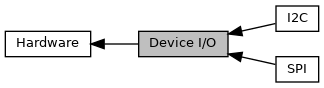
A bus-agnostic interface for transferring data to and from addressable devices - register reads/writes and raw transfers - without the caller needing to know whether the underlying bus is I2C, SPI, or (in future) something like an FTDI adapter.
More...
|
| | I2C |
| | Inter-Integrated Circuit (I2C) interface for hardware platforms.
|
| |
| | SPI |
| | Serial Peripheral Interface (SPI) interface for hardware platforms.
|
| |
|
|
#define | HW_DEVICEIO_CAPACITY 8 |
| | Maximum number of open device I/O handles, across every backend (SPI, I2C, ...) combined.
|
| |
|
#define | HW_DEVICEIO_CONTEXT_SIZE 32 |
| | Size in bytes of the per-handle scratch context space embedded in every hw_deviceio_t, for a backend's own private per-device state.
|
| |
|
| enum | hw_deviceio_bus_t { hw_deviceio_i2c,
hw_deviceio_spi
} |
| | Which bus backs a device I/O handle.
|
| |
|
| size_t | hw_deviceio_xfr (hw_deviceio_t *device, void *data, size_t tx, size_t rx, uint32_t timeout_ms) |
| | Perform a raw, bidirectional transfer. More...
|
| |
| size_t | hw_deviceio_read_reg (hw_deviceio_t *device, uint8_t reg, void *data, size_t len, uint32_t timeout_ms) |
| | Read bytes from a register on a device. More...
|
| |
| size_t | hw_deviceio_write_reg (hw_deviceio_t *device, uint8_t reg, const void *data, size_t len, uint32_t timeout_ms) |
| | Write bytes to a register on a device. More...
|
| |
A bus-agnostic interface for transferring data to and from addressable devices - register reads/writes and raw transfers - without the caller needing to know whether the underlying bus is I2C, SPI, or (in future) something like an FTDI adapter.
hw_deviceio_t is the one handle type every backend hands back - hw_spi_init*() (see spi.h) and hw_i2c_init*() construct and fully own one directly, rather than wrapping some separate hw_spi_t/hw_i2c_t - so a device driver written against hw_deviceio_t works unchanged regardless of which bus actually carries it.
◆ hw_deviceio_bus()
Get which bus backs a device I/O handle.
- Parameters
-
- Returns
- The bus
device was constructed against, or hw_deviceio_i2c if device is invalid.
◆ hw_deviceio_deinit()
Release a device I/O handle.
- Parameters
-
Fully releases whatever backend resources device holds (e.g. an SPI adapter's claimed pins, an I2C bus's peripheral) as well as the handle itself - there is no separate bus-specific deinit to call afterward. Safe to call on NULL.
◆ hw_deviceio_read_reg()
| size_t hw_deviceio_read_reg |
( |
hw_deviceio_t * |
device, |
|
|
uint8_t |
reg, |
|
|
void * |
data, |
|
|
size_t |
len, |
|
|
uint32_t |
timeout_ms |
|
) |
| |
Read bytes from a register on a device.
- Parameters
-
| device | Device handle. |
| reg | Register address to read from. |
| data | Buffer to receive the bytes. |
| len | Number of bytes to read. |
| timeout_ms | Timeout in milliseconds for the operation. Set to 0 to use the backend's default transfer path. |
- Returns
- Number of bytes read, or
0 on failure.
◆ hw_deviceio_write_reg()
| size_t hw_deviceio_write_reg |
( |
hw_deviceio_t * |
device, |
|
|
uint8_t |
reg, |
|
|
const void * |
data, |
|
|
size_t |
len, |
|
|
uint32_t |
timeout_ms |
|
) |
| |
Write bytes to a register on a device.
- Parameters
-
| device | Device handle. |
| reg | Register address to write to. |
| data | Buffer containing bytes to write. |
| len | Number of bytes to write. |
| timeout_ms | Timeout in milliseconds for the operation. Set to 0 to use the backend's default transfer path. |
- Returns
- Number of bytes written, or
0 on failure.
◆ hw_deviceio_xfr()
| size_t hw_deviceio_xfr |
( |
hw_deviceio_t * |
device, |
|
|
void * |
data, |
|
|
size_t |
tx, |
|
|
size_t |
rx, |
|
|
uint32_t |
timeout_ms |
|
) |
| |
Perform a raw, bidirectional transfer.
- Parameters
-
| device | Device handle. |
| data | Buffer used for transmitted and received bytes. |
| tx | Number of bytes to transmit from data. |
| rx | Number of bytes to receive into data + tx. |
| timeout_ms | Timeout in milliseconds for the operation. Set to 0 to use the backend's default transfer path. |
- Returns
- Number of bytes transferred, or
0 on failure.
Supports write-only (tx > 0, rx == 0), read-only (tx == 0, rx > 0), and write-then-read (tx > 0, rx > 0) transfers. The exact semantics of a write-then-read - a repeated start on I2C, a continuous chip-select assertion on SPI - are defined by whichever bus device is actually bound to.