The System module provides the runtime foundation used by higher-level Picofuse components. More...
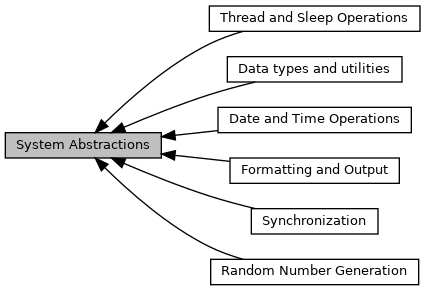
Collaboration diagram for System:
|
Modules | |
| Memory | |
| Memory allocation primitives: arenas and the default heap wrappers built on them. | |
| Events | |
| The core event transport abstraction used by runloops and other producer/consumer workflows. | |
| Synchronization | |
| Mutexes, condition variables, wait groups, and atomic values used to coordinate access to shared state across threads. | |
| Data types and utilities | |
| Runes and strings, the flag-driven scanner built on them, and the stream I/O they read from. | |
| Execution | |
| Runtime execution: threads, pausing/stopping the process, and environment/signal integration. | |
Files | |
| file | assert.h |
| Defines a custom assertion macro. | |
| file | init.h |
| System initialization and cleanup hooks. | |
| file | panicf.h |
Defines the sys_panicf function for formatted panic messages. | |
Macros | |
| #define | sys_assert(condition) |
| Asserts that a condition is true. More... | |
Typedefs | |
| typedef enum sys_stdio_t | sys_stdio_t |
| Standard input/output backend types. | |
Enumerations | |
| enum | sys_stdio_t { sys_stdio_none = 0, sys_stdio_uart, sys_stdio_usb, sys_stdio_rtt } |
| Standard input/output backend types. More... | |
Variables | |
| sys_iostream_t * | sys_stdout |
| Standard output stream. More... | |
| sys_iostream_t * | sys_stdin |
| Standard input stream. More... | |
Lifecycle | |
| void | sys_init (int argc, char *argv[], size_t arena_size, sys_stdio_t stdio) |
| Initializes the system on startup. More... | |
| void | sys_exit (void) |
| Cleans up the system on shutdown. | |
Detailed Description
The System module provides the runtime foundation used by higher-level Picofuse components.
It includes cross-platform abstractions for memory, threading, synchronization, timing, event queues, runloops, diagnostics, environment metadata, and process control.
Macro Definition Documentation
◆ sys_assert
| #define sys_assert | ( | condition | ) |
Value:
do { \
if (!(condition)) { \
sys_panicf("[ASSERT] FAIL: %s, file %s, line %d", #condition, __FILE__, \
__LINE__); \
} \
} while (0)
Asserts that a condition is true.
- Parameters
-
condition The condition to check.
If the condition is false, it will call panicf with an assertion failure message, including the condition, file name, and line number.
Enumeration Type Documentation
◆ sys_stdio_t
| enum sys_stdio_t |
Function Documentation
◆ sys_init()
| void sys_init | ( | int | argc, |
| char * | argv[], | ||
| size_t | arena_size, | ||
| sys_stdio_t | stdio | ||
| ) |
Initializes the system on startup.
- Parameters
-
argc Argument count, as passed to main().argv Argument vector, as passed to main(). On platforms with no real command line (such as Pico), pass0/NULL; nothing reads them.arena_size Capacity in bytes for the default arena backing sys_malloc()/sys_calloc()/sys_realloc()/sys_free() (see sys/mem.h), or 0to leave them routed straight through to the system allocator instead.stdio Standard input/output backend to initialize. Pass sys_stdio_none to select the platform default.
Variable Documentation
◆ sys_stdin
| sys_iostream_t* sys_stdin |
Standard input stream.
Set by sys_init(), or NULL if no input stream is available.
◆ sys_stdout
| sys_iostream_t* sys_stdout |
Standard output stream.
Set by sys_init(), or NULL if no output stream is available.